
Urdu
- Home
- Urdu
Why Study Urdu? A Heritage Language!
Urdu is one of the world’s most beautiful and expressive languages, renowned for its rich literary heritage, elegant poetry and cultural significance. Studying Urdu at GCSE, IGCSE or A Level enables students to develop excellent reading, writing, speaking and analytical skills while strengthening their understanding of history, literature and culture.
For many students, Urdu is not only a school subject but also an important part of their identity and family heritage. A strong command of Urdu helps students communicate confidently with millions of people around the world, appreciate classical and modern literature, and preserve an important cultural tradition for future generations.
Learning Urdu also develops valuable language skills that support learning in other subjects and enhance communication in both personal and professional life.
Urdu Opens the Door to Many Careers
A strong knowledge of Urdu is highly beneficial for careers and university degrees in:
- Teaching and Education
- Urdu Literature
- Linguistics
- Translation and Interpretation
- Journalism
- Media and Broadcasting
- Publishing and Editing
- Creative Writing
- Law
- International Relations
- Diplomacy
- Civil Service
- Public Administration
- Tourism and Hospitality
- Business Management
- Marketing and Advertising
- Social Work
- Community Development
- Psychology
Bilingual professionals who are fluent in both English and Urdu are often valued in education, healthcare, legal services, government organisations and international businesses that serve Urdu-speaking communities.
Urdu in Everyday Life
Urdu is used every day by millions of people for communication, education, literature, media and business. It allows individuals to communicate with family members, participate in cultural events, enjoy poetry and literature, and build strong relationships within local and international communities.
Studying Urdu also improves vocabulary, reading comprehension, writing ability and confidence in public speaking, all of which are valuable throughout life.
Where Will I Use This in Real Life?
You will use Urdu in many practical situations, including:
- Communicating confidently with family, friends and Urdu-speaking communities.
- Reading newspapers, books, novels and poetry.
- Writing letters, emails and formal documents.
- Working in education, journalism, broadcasting and publishing.
- Translating information between Urdu and English.
- Supporting patients and clients in healthcare, legal and community services.
- Working with government departments and public organisations.
- Promoting businesses through Urdu-language advertising and media.
- Preserving cultural heritage by understanding classical and modern literature.
- Building stronger communication skills in multilingual workplaces.
Whether you pursue a career in education, media, business or public service, Urdu can be a valuable asset in both Pakistan and many other countries.
Skills You Develop Through Urdu
Studying Urdu helps students develop a wide range of transferable skills, including:
- Reading comprehension
- Creative and formal writing
- Effective communication
- Vocabulary development
- Critical thinking
- Literary analysis
- Public speaking
- Translation skills
- Cultural awareness
- Research skills
- Confidence in bilingual communication
These skills are valuable in higher education and in many professional careers.
Fascinating Facts About Urdu
Urdu has a rich history and continues to be an important language around the world.
- Urdu developed over several centuries through the interaction of different cultures and languages in South Asia.
- It is the national language of Pakistan and is spoken and understood by millions of people worldwide.
- Urdu uses a modified Perso-Arabic script and is written from right to left.
- Many Urdu words have roots in Persian, Arabic, Turkish and local South Asian languages, giving it a rich and diverse vocabulary.
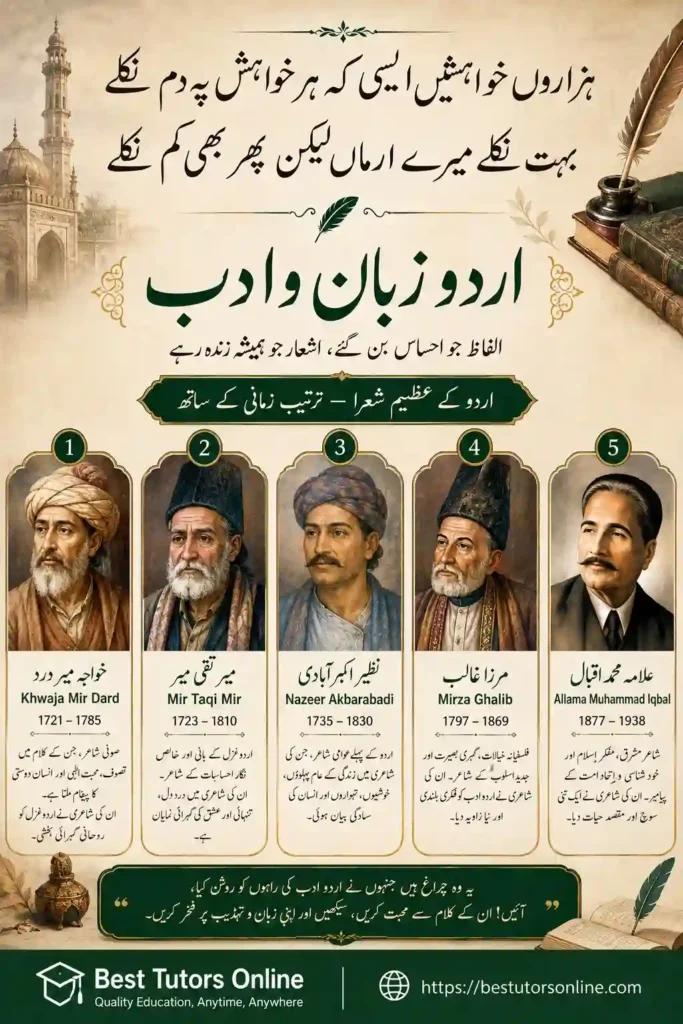
- Urdu is internationally recognised for its beautiful poetry, including the works of renowned poets such as Allama Muhammad Iqbal, Mirza Ghalib, Faiz Ahmed Faiz and Mir Taqi Mir.</b?
- Urdu literature includes poetry, novels, short stories, essays and plays that have influenced generations of readers.
- Learning Urdu alongside English strengthens bilingual communication skills and can improve understanding of language structure and vocabulary.
- Urdu is widely used in literature, television, radio, films, newspapers and digital media throughout Pakistan and among Urdu-speaking communities around the world.
Why Choose Best Tutors Online?
At Best Tutors Online, we believe that learning Urdu is about more than achieving excellent examination results. It is about developing strong communication skills, appreciating a rich literary heritage and building confidence in reading, writing and speaking.
Our experienced tutors prepare students thoroughly for GCSE, IGCSE and A Level examinations by strengthening grammar, vocabulary, comprehension, essay writing and literary analysis. Through engaging lessons and personalised support, we help students achieve academic success while developing a lifelong appreciation for the beauty and importance of the Urdu language.
Why Learn Urdu as a Heritage Language?
Learning Urdu helps students communicate confidently with family members, understand their cultural heritage, enjoy classical and modern literature, and maintain strong connections with Urdu-speaking communities around the world. Being fluent in both English and Urdu is a valuable skill that can open doors to education, employment and international opportunities.